


BlackRock’s head of crypto, Robbie Mitchnick, says the gravitational heart of Bitcoin’s marketplace construction has shifted decisively from miner issuance to exchange-traded fund call for—and that’s why vintage four-year “halving cycles” will have to command some distance much less consideration than they used to. In a Bankless interview launched November 10, Mitchnick argued that the ETF generation is now the dominant go with the flow regime for BTC, at the same time as leverage and temporary derivatives noise proceed to whipsaw costs.
ETF Inflows Now Dwarf The Bitcoin Halving
“It’s no longer over,” Mitchnick stated when requested whether or not the most recent sell-off marked the top of Bitcoin’s present cycle. “That is the 5th cycle we’ve observed […] via every successive cycle, the extent that Bitcoin reached used to be vastly upper than the prior cycle.” He added a pointed caveat for somebody nonetheless treating halvings because the metronome of BTC: “Numerous other people imagine the cycle is tied to [the] Bitcoin halving. The Bitcoin halving at this level is nearly utterly beside the point […] when ETFs are amassing inflows, the magnitude of the ones inflows is many, many multiples better than any trade in provide created via a Bitcoin halving match.”
Mitchnick’s framing places Wall Side road, no longer the protocol time table, on the heart of the following segment. BlackRock’s spot Bitcoin ETF, IBIT, “has been the fastest-growing ETF post-launch in historical past,” he stated, attaining milestones at kind of 4 occasions the tempo of the former document. Extra telling than uncooked AUM, in his view, is the converting composition of holders. Within the first quarter after release, “IBIT used to be over 80% direct retail buyers. Each and every quarter thereafter that quantity has come down […] these days it’s as regards to 50%,” reflecting the stable upward push of wealth advisory and institutional channels.
That institutional cohort continues to be early, however broadening. “Should you take into accounts the large classes of institutional buyers, you’ve were given circle of relatives places of work, asset managers, sovereign wealth budget, college endowments, foundations, company treasurers, insurers, pension budget. You’ve gotten some adopters in each a kind of archetypes, however no longer the bulk, no longer even shut,” he stated.
For the ones allocating, standard place sizes land within the “1% to a few% vary.” The gating issue, once more, is much less about custody or get entry to—and extra about how Bitcoin behaves within a portfolio. “It’s all about correlation,” Mitchnick famous, recounting a dialog with a pension CIO who’s “actually” staring at that metric. If Bitcoin consistently tracks “virtual gold” slightly than “levered NASDAQ,” he argued, “it’s a slam dunk to position a pair proportion of portfolio allocation in it.”
The stress is that temporary marketplace motion nonetheless seems like crypto. Mitchnick referred to as the October 10 washout—kind of “$21 billion in liquidations”—a leverage match slightly than a shift in basics, and contrasted it with the stability of fund patrons: “What used to be the affect on ETF outflows? Tiny […] a pair hundred million.” That discrepancy, he stated, is exactly why cycles will have to attenuate through the years: a bigger, slower-moving base of ETF and advisory capital can soak up derivatives-driven shocks with out routinely exiting.
He additionally driven again on narratives that Bitcoin’s 2025 underperformance as opposed to gold invalidates the “uncorrelated hedge” thesis. The virtual asset, he argued, already banked its “debasement business” in overdue 2024, rallying from the “prime $60s to over $100K,” or even notched a brand new all-time prime round $126,000 earlier than the October crash “derailed the momentum.” In different phrases, the year-to-date scoreboard displays sequencing and leverage, no longer a structural repudiation of Bitcoin’s store-of-value pitch.
On provide dynamics, Mitchnick said that legacy cohorts have taken earnings at mental ranges, however he pushed aside the concept Bitcoin is in an “IPO second” the place early adopters completely hand the go with the flow to establishments. What’s extra believable, he stated, is inconspicuous menace control via ultra-early holders whose foundation sits at “$100 or $500,” lots of whom had $100,000 as a round-number trim goal. “One day you do must take some chips off the desk,” he stated, including that long-term efficiency has preferred endurance over temporary, levered buying and selling.
Mitchnick used to be cautious to not oversell common adoption amongst giant swimming pools of capital. Central banks, he recommended, stay a tail-risk purchaser slightly than a base case. The near-term trail as an alternative runs throughout the establishments already tiptoeing in—pensions, insurers, sovereign wealth budget—whose conviction will hinge on medium-term conduct and coverage readability.
The message for allocators going through their first complete drawdown with ETFs are living used to be direct: don’t mistake derivatives noise for damaged basics, and be selective. “There’s a reason why Bitcoin continues to be kind of 65% of the marketplace cap of the distance,” he stated. “One must be very cautious going some distance down the desk […] nearly all of [tokens] are or can be utterly nugatory.”
For Bitcoin, the take a look at is whether or not it assists in keeping behaving like what establishments assume they’re purchasing. “Other people have to appear past those temporary strikes […] and extra about, you recognize, medium and long run how does it observe,” Mitchnick stated.
At press time, BTC traded at $105,497.
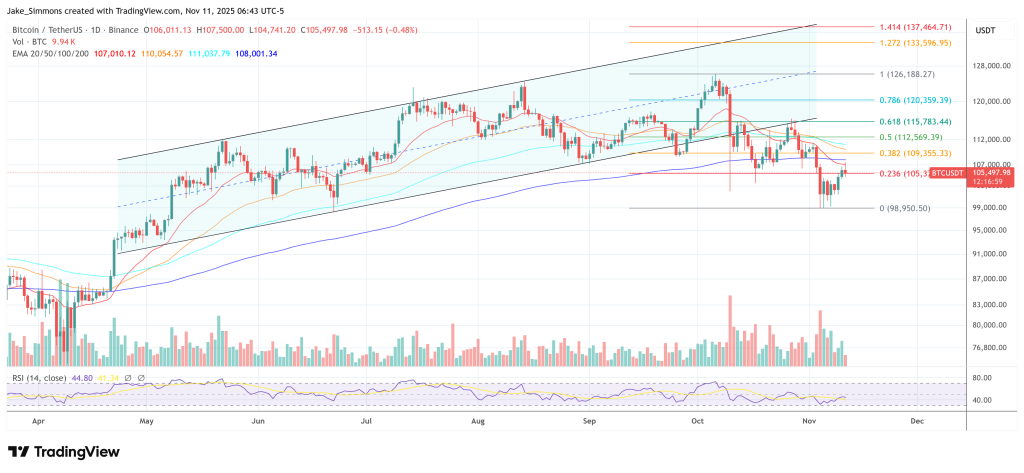
Featured symbol created with DALL.E, chart from TradingView.com
Editorial Procedure for bitcoinist is targeted on handing over completely researched, correct, and independent content material. We uphold strict sourcing requirements, and every web page undergoes diligent assessment via our workforce of most sensible era mavens and seasoned editors. This procedure guarantees the integrity, relevance, and worth of our content material for our readers.
