
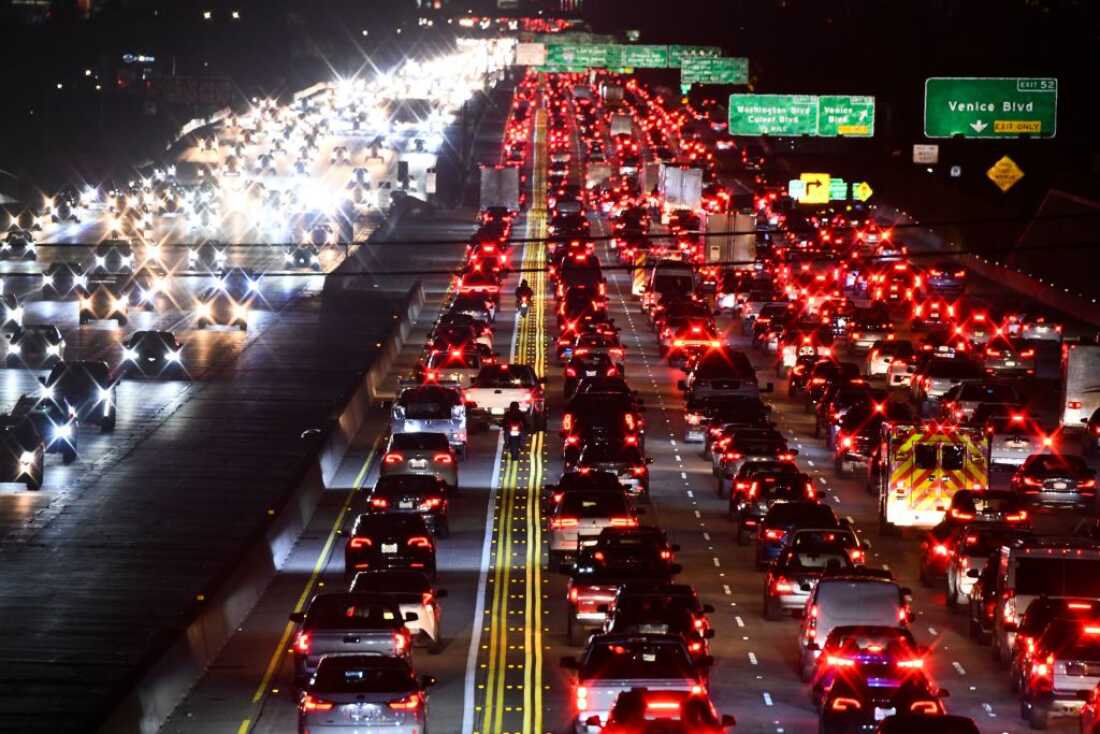

Rush-hour visitors on Interstate 405 in Los Angeles in March 2022. After losing right through the COVID-19 pandemic, congestion ranges reached a file top ultimate yr, researchers say.
Patrick T. Fallon/AFP by means of Getty Photographs
conceal caption
toggle caption
Patrick T. Fallon/AFP by means of Getty Photographs
A couple of weeks in the past, Taelyr Vecchione vented her rising frustration with visitors in San Diego.
“Do you take into account when visitors began at, like, 5?” she mentioned in this video posted on TikTok. Vecchione filmed herself sitting in her automotive, lamenting how issues in her Southern California homeland have modified.

“Now,” she says, “there’s at all times visitors. At all times!”
In reality, there’s knowledge to again her up in this. San Diego has observed an important leap in visitors delays, researchers say, as congestion around the U.S. climbed to file ranges in 2024.
If it sort of feels like visitors is getting worse the place you reside, that is as it most probably is. After losing right through the COVID-19 pandemic, researchers say, congestion has equaled — and, in lots of puts, surpassed — pre-pandemic ranges. And the ones delays are spreading to extra instances of day and extra days of the week.
“We’re again. However the extend more or less has a unique really feel to it than it did prior to,” mentioned David Schrank, a senior analysis scientist on the Texas A&M Transportation Institute, which has tracked congestion because the Eighties in its annual City Mobility Record.

For many years, Schrank says, the ones patterns slightly budged. Then got here 2020, when congestion plunged right through the pandemic lockdown. Now it is again at file ranges, he says, with the common American spending 63 hours according to yr caught in visitors.
There are any other notable variations from previous years too. The frenzy-hour peaks are nonetheless the worst instances to force, Schrank says, however there is extra congestion at different instances of day as smartly.
“It is unfold out over extra of the day, and thus it is not only a commuter factor,” Schrank mentioned in an NPR interview. “Everyone seems to be experiencing extra of that extend.”

The ones are not the one adjustments researchers are seeing within the knowledge. Schrank says there is extra extend on weekends. Visitors on Mondays has a tendency to be noticeably lighter than at the different weekdays, he mentioned, whilst Thursday has just about stuck up with Friday because the heaviest visitors day of the week.
“There is extra variability everyday than there was once pre-pandemic. The day of the week issues, and the time of the day issues,” Schrank mentioned.
Vehicles are inflicting extra congestion as smartly, consistent with the Texas A&M record. Whilst some truck visitors shifted towards off-peak hours right through 2020 and 2021, the newest knowledge presentations that truck-related delays right through rush hour are mountain climbing again towards their pre-pandemic degree.
Schrank and his colleagues ranked each and every metropolitan space within the U.S. via hours of visitors extend. San Diego noticed the most important share leap in hours of extend according to commuter since 2019, at greater than 37%. Miami, Phoenix and the San Francisco Bay House noticed important jumps too.
However no town stuck as much as Higher Los Angeles, the place the common commuter misplaced 137 hours to delays ultimate yr, consistent with the Texas A&M record.

Visitors on Interstate 210 right through the morning trip in Pasadena, Calif., this month. Researchers say the common driving force in Los Angeles misplaced 137 hours to visitors delays in 2024, essentially the most of any U.S. town.
Mario Tama/Getty Photographs
conceal caption
toggle caption
Mario Tama/Getty Photographs
That got here as no nice wonder to Michael Manville, a professor of city making plans on the College of California, Los Angeles. He warns in opposition to studying an excessive amount of into the person town scores however says the entire findings make sense.
“Congestion strikes in large part in sync with broader patterns in regional economies. And so when you’ve got the economic system doing smartly, congestion has a tendency to be worse. You probably have a recession, it has a tendency to be a bit bit higher,” Manville mentioned.
Researchers at Texas A&M additionally recognized a couple of areas the place congestion is down in comparison with prior to the pandemic — maximum particularly, Washington, D.C. Which may be related to the patience of faraway paintings within the federal executive in 2024. And it may additionally have one thing to do with regional efforts to struggle congestion, together with a tolling technique referred to as dynamic pricing.
“If you will give a contribution to the over the top congestion right through the height and the night time rush hours most likely, you will be paying extra for the tolls,” mentioned Robert Puentes, a vice chairman and transportation professional on the Brookings Establishment.
Puentes lives in Northern Virginia, which has followed an intensive device of tolls on primary highways that price other costs at other instances. And he says that this turns out to lend a hand cut back congestion.
“It is one thing that in reality might be acceptable in different metropolitan spaces. We see puts in Texas and California, elsewhere, which can be the usage of it. I feel it has an actual long term on this nation,” Puentes mentioned.
Any other bold effort to struggle congestion is occurring in New York Town, the place automotive drivers now pay up to $9 to go into Decrease Big apple.
That congestion pricing plan has already reduce visitors within the toll zone since its release in January. However it is nonetheless too early to mention how a lot it is converting commuting patterns around the area.
